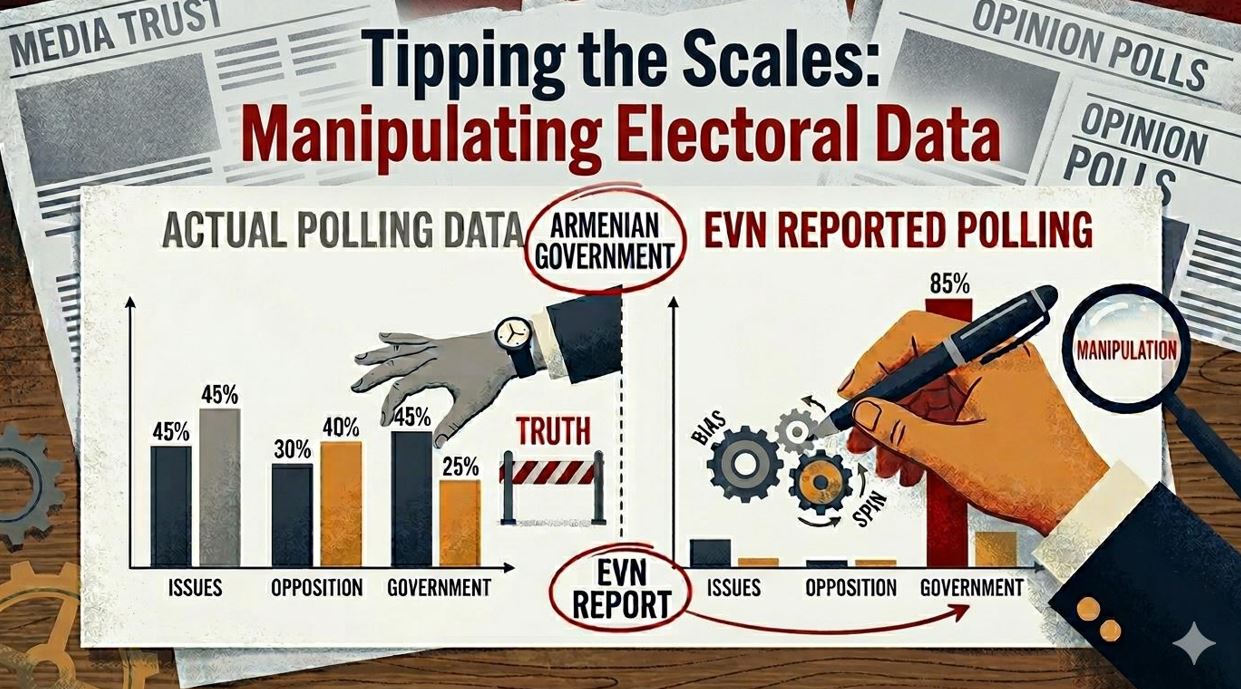
EVN Report’s “Survey Waves” and the Tsunami of Misinformation
On February 26, 2026, just months ahead of the June 7, 2026 Parliamentary elections in Armenia, EVN Report published a piece authored by Nerses Kopalyan and Rafael Oganesyan entitled, “Undecideds Swing New Poll Numbers: Armenia’s Parliamentary Elections Take Shape.”
The article, based on an EVN Report survey conducted by the Armenian Election Study (ArmES), is self-described as the first wave in a three-wave polling series and is framed as “the first survey of its kind to be produced in Armenia.” A bold claim indeed, considering Armenia has a relatively robust recent history of polling by organizations such as Gallup International Association, CRRC, IRI, Edison Research, and others. EVN Report, also, recently published a third piece in the now close run-up to elections, on May 6, 2026, entitled, “Incumbent Improves, Opposition Fragments: Armenia’s Parliamentary Elections Take Shape.”
These articles project an image of being theoretically well-grounded, methodologically sophisticated, and judicious in their analysis, however, the authors leverage the reputation of the American National Election Studies (ANES) and employ additive index modeling to forecast voter behavior. And, once the reader moves beyond the technical language and statistical framing, the reports, to say the least, leave a lot to be desired. As presented, the reports reflect conceptual ambiguity, excessive inferential claims, unclear modeling procedures, and interpretive bias that seriously undermine their conclusions.
Here, the reports are critiqued along several dimensions related to sampling and design, interpretive claims that go beyond what data supports, modeling of undecided voters, and normative framing couched in analytical language.
Sampling and Design: The Illusion of Methodological Parity with ANES
The reports repeatedly invoke ANES as a benchmark, yet the comparison quickly unravels. ANES uses mixed-mode sampling, large national samples (often 4,000+), pre- and post-election panels, transparent weighting, and extensive validation. ArmES relies solely on telephone sampling, has 820 respondents in the first wave, is strictly pre-electoral, and provides no weighting discussion nor response rate disclosure. Invoking ANES lends rhetorical authority, but does not establish methodological equivalence. The reported 3.4% margin of error applies only to simple random samples and single estimates. With 36.7% undecided/refusing, subgroup results are statistically tenuous. The claimed equivalency reads more like branding than rigorous substantiation.
In short, the comparison to ANES gives the impression that the ArmES survey operates at the same level of methodological rigor. However, the underlying designs are substantially different in sample size, data collection methods, and transparency.
Over-Interpretation of Ambiguous Data
The first report repeatedly reframes neutral or weakly supported findings as “cautious optimism.” Retrospective economic perceptions are nearly split (37.9% worse, 32% better, 19% unchanged, 7% don’t know), while prospective outlooks show a surge in “don’t know” responses (27.9%). Interpreting this uncertainty as moderation is simply speculative. Rising uncertainty signals volatility, confusion, or distrust, not optimism. Similarly, the electorate is nearly evenly divided on the country’s direction (37.9% wrong track, 34.9% right track, 26.5% undecided), yet the report reads this split as “cautious optimism.” A plurality seeing the country on the wrong track is division, not optimism.
Put simply, the data itself does not indicate optimism. Instead, it shows a public that is divided and uncertain about both the economy and the country’s overall direction. Interpreting these mixed and ambiguous responses as “cautious optimism,” therefore, stretches what the numbers actually demonstrate. The results point more toward uncertainty and polarization than toward a broadly positive outlook.
The Additive Index: Predictive Power or Circular Design?
The report’s most consequential claim converts undecided voters into a 40.5% projected vote share using a 0-3 additive scale based on three positional items: Justice/accountability, security improvement, and TRIPP policy evaluation. These questions are framed so that selecting a particular answer aligns with the incumbent, creating three core concerns:
- Issue Selection Bias
Only three issues are included, with critical dimensions like corruption, broader territorial security, governance competence, trust in institutions, and foreign policy alignment completely ommotted. Skewed issue selection turns the additive scale into a product of survey design rather than genuine voter priorities.
- Proximity Assumption
The model equates agreement with the government on these issues to voter intention. Voters may approve policies but reject leadership style, execution, or party identity. Policy alignment does not equal partisan commitment.
.
- Conversion of “Likelihood” into Vote Share
The leap from 46.3% of undecided voters reporting they are “more likely” or “most likely” to vote for Civic Contract to a 40.5% vote share relies on strong assumptions: Namely, that likelihood equals realized vote, an even turnout distribution, no counter-mobilization, no late shifts, no asymmetric effects. This is probabilistic overextension. A likelihood gradient is not a vote commitment. Converting it into projected vote share inflates predictive certainty.
In simpler terms, saying someone is “more likely” to vote for a party is not the same as saying they will actually vote for it. Many things can change before election day, including turnout, campaign dynamics, and late voter decisions. Treating these probabilities as if they were firm votes therefore creates a level of certainty that the data itself does not support.
The Iran War Question: Loaded Language, Selective Emphasis, and Misleading Analysis
In the third wave of the EVN Report survey, a fourth positional question regarding the Iran war was added, providing further proof of bias in how their questions were framed, but especially in their interpretation of the results. The presentation of the polling results is dubious and misleading, employing loaded wording and analysis that steers the reader toward a favorable interpretation of the Armenian Government’s position.
The following points warrant substantial concern regarding EVN Report surveys and will, hopefully, aid in further elucidating the greater, real issues at hand:
- Linguistic Framing and Biased Word Choice
The following is stated: “…indicating broad support for how the Armenian Government has handled the geopolitical flareup.”
The numbers, as noted below, do not at all justify such a strong interpretive conclusion:
42.8% approved
20.9% disapproved
The above percentages indicate that roughly 36% of the respondents were undecided, refused to answer, or were neutral.
Considering these results, calling the outcome “broad public support” clearly overstates the findings as less than a majority explicitly approved. To frame it as “broad public support” implicitly encourages the reader to understand the government position as a widely accepted fact. If appropriate language were used, such as “approval exceeded disapproval among respondents,” the bias, which seems intentional, would have been avoided.
- Presenting Undecided Responses as Indirect Support
The following is stated: “The disaggregated data of the non-committed respondents also demonstrates [sic] support for the government’s foreign policy…”
This definitive conclusion is then followed by a statement that 46.5% of the responses were “don’t know” or “refuse to answer.” In light of this fact, the above conclusion creates, at best, a logical inconsistency. When nearly half of the respondents are unsure about the issue or unwilling to respond, how could the results be interpreted as support for the government’s foreign policy? Given that level of uncertainty, the claim that the subgroup is “demonstrating support” is not tenable. Disingenuously, the interpretation selectively emphasizes approval percentages while minimizing uncertainty. In fact, the results indicate that the issue is less salient or less understood and many respondents do not hold settled or informed opinions.
- Skewed Emphasis and Framing Imbalance
The text emphasizes interpretations such as “broad public support,” “demonstrates support,” and “more telling result,” while systematically underrepresenting alternative explanations, including a large undecided bloc, low issue familiarity, and the possibility of insufficient respondent information. This creates narrative framing bias even if the raw numbers are accurate.
- Summary Assessment
The report mostly presents the narrative and interpretation of the survey and not the verbatim survey instrument, thus making it difficult to assess if the survey question itself is necessarily biased. However, it is clear that the presentation and interpretation of the results are biased. The signs of interpretive framing bias are obvious: Overstating approval; characterizing pluralities as “broad support”; treating uncertainty as indirect endorsement; consistently framing results in ways favorable to the government. Wave 3, as Wave 1 and Wave 2, reads more like persuasive political analysis than strictly neutral polling interpretation. Looking at the EVN Report’s history, this surely is not a coincidence.
Turnout Modeling Assumptions
Although actual turnout in 2021 was only 49.3%, and survey self-reports overestimate by 10-30%, the report models turnout at 82%, claiming this is “conservative.” This is counterintuitive. If turnout is closer to 55-60% and dominant parties benefit from lower participation, the 82% assumption artificially stabilizes projections in favor of the incumbent. Yet, no empirical evidence is provided to justify turnout elasticity by party. The argument is asserted, not demonstrated.
Put simply, the model assumes that more than 8 out of 10 voters will participate, even though recent elections and most surveys suggest turnout is usually much lower. When turnout is assumed to be unrealistically high, it can make projected results look more stable than they actually are. Without clear evidence explaining why turnout would reach such a level, the assumption remains speculative rather than empirically supported.
Citizen Forecasting: Perception vs. Bandwagon
The report introduces citizen forecasting, claiming it has performed well in the United States. Yet, such forecasts can reflect bandwagon effects, perceived media dominance, incumbency heuristics, or strategic resignation. A majority predicting Civic Contract victory does not signal democratic endorsement; it may simply reflect perceived inevitability. While the report briefly notes possible turnout complacency, it neglects the alternative: That perceived inevitability could suppress opposition turnout or reveal underlying structural dominance.
Normative Framing and Embedded Value Language
Several phrases subtly embed normative judgements (e.g., “Democratic opposition absent from the electoral domain,” “Pro-Western, pro-Velvet party,” “Anti-Pashinyan vote,” “Pro-Russia, anti-Velvet Revolution party.”) These labels introduce evaluative coding into what purports to be objective or neutral survey analysis. Descriptive analysis should avoid classifying parties along normative or ethno-political axes unless these dimensions are explicitly operationalized.
The “Non-Committed” Problem
36.7% of respondents are undecided or refuse. This is an extraordinarily high share. Rather than treating this as instability, volatility, or distrust, the authors exploit undecided respondents to steer projections. They are treated as a reservoir to be mined directionally. Such high undecided rates indicate low party institutionalization, fluid political identities, weak partisan anchoring, and information deficits, making predictive modeling inherently unstable, if not unreliable.
What the Data Actually Suggests
Stripped of interpretive framing, the data reveals an underwater prime minister approval rating, a plurality dissatisfied with the country’s direction, predominantly pessimistic retrospective assessments of the economy, high uncertainty about the future, and a large, undecided voter bloc. Incumbent support is only a plurality, not a majority. This is not consolidation. It is fragmentation.
The Central Overreach
The report’s strongest claim, “Civil Contract currently has a vote share of 40.5%,” rests entirely on three selected issue items, a constructed additive index, likelihood scaling treated as vote commitment, and an 82% turnout assumption. Remove any one of these pillars, and the projection collapses. The observable base is 26.1%. Everything beyond that is modeling. Modeling is not reality. While the report correctly notes that surveys are snapshots in time, its treatment of undecided voters converts a snapshot into a forecasted electoral architecture with far more certainty than the data justifies.
Conclusion: Methodological Shortcomings or Structured Bias?
Two broad interpretations remain possible when evaluating the weaknesses identified in the ArmES report. The first is methodological: the survey may simply suffer from design limitations that produced analytical distortions. The second is interpretive: the survey may be presented as neutral and objective while its structure subtly channels responses toward predetermined conclusions. While both possibilities merit consideration, the internal structure of the report suggests that the latter explanation deserves closer scrutiny.
One charitable reading is that the shortcomings stem from methodological inexperience or design constraints rather than intent. Survey research, particularly in electoral environments characterized by high volatility and weak partisan attachment, is inherently difficult. Small samples, telephone-only data collection, incomplete disclosure of weighting procedures, and limited issue batteries can generate misleading analytical results even when researchers act in good faith. In this interpretation, the report’s central problems arise from overconfidence in modeling techniques applied to a relatively thin empirical foundation. The additive index may simply reflect a misguided attempt to operationalize voter preferences using too few variables. Similarly, the ambitious conversion of likelihood scales into projected vote share could represent analytical enthusiasm rather than deliberate distortion. If this is the case, the issue is not bias, but methodological overreach: the use of sophisticated statistical language to compensate for limited data. Such errors are not uncommon in early survey waves, especially when researchers attempt to produce headline-grabbing interpretations before sufficient data accumulation.
However, the alternative interpretation raises more serious concerns. The structure of the survey instrument itself suggests that the research design may be consciously oriented toward generating a particular narrative. The most consequential modeling step in the report—the conversion of undecided voters into a projected 40.5% vote share for Civic Contract—depends heavily on three issue questions whose framing aligns responses with positions associated with the incumbent government. When only a narrow set of policy dimensions is included, and those dimensions correspond closely with the governing party’s messaging, the resulting index risks measuring agreement with the framing of the questions rather than genuine voter intention.
In this sense, the survey may not be technically falsifying data, but is, in fact, structuring the measurement process in a way that channels interpretation in a predetermined direction. This is a well-known problem in survey methodology and a tactic in swaying election outcomes: Neutrality can be compromised not through manipulation of results, but through the design of questions, the selection of variables, and the interpretive narrative built around them. By choosing which issues to measure and which to omit, researchers can effectively shape the analytical space within which conclusions emerge. When critical topics such as corruption, governance competence, broader security concerns, or institutional trust are excluded, the resulting model inevitably reflects the priorities embedded in the questionnaire (and questioners) rather than the priorities of the electorate.
The treatment of undecided voters further reinforces this concern. Instead of recognizing a 36.7% undecided bloc as evidence of volatility and weak partisan attachment, the report converts this uncertainty into directional probability. Undecided voters become a statistical reservoir from which projected support for the incumbent is extracted. The modeling therefore transforms ambiguity into apparent stability. While technically framed as probabilistic estimation, the practical effect is to replace uncertainty with a narrative of consolidation.
The distinction between methodological error and structured bias ultimately hinges on transparency. Robust survey research typically exposes its assumptions to scrutiny: Full question wording, weighting procedures, response rates, model specifications, and sensitivity analyses are openly presented. In the absence of such transparency, it becomes difficult to determine whether analytical outcomes arise from methodological necessity or from deliberate design choices that favor a particular interpretation.
Regardless of which explanation proves more accurate, the implications remain significant. If the weaknesses result from methodological limitations, the report should be treated as a preliminary exploratory exercise whose conclusions require substantial caution. If, however, the survey design itself embeds directional assumptions, then the report functions less as neutral measurement and more as narrative construction presented under the authority of quantitative analysis.
In either case, the central takeaway remains unchanged. The data presented in the first wave of ArmES does not demonstrate electoral consolidation or clear incumbent dominance. At most, it reveals a fragmented electorate marked by uncertainty, divided evaluations of national direction, and a large bloc of voters whose preferences remain unsettled. Transforming such conditions into confident projections of electoral outcomes requires analytical assumptions that extend well beyond what the underlying data can sustain.
The fundamental question, therefore, is not whether modeling techniques can be applied to uncertain electorates, but whether the design of those models faithfully reflects the complexity of the political environment they seek to measure. In this instance, the gap between data and interpretation suggests that the modeling framework is geared toward influencing far more than the evidence itself.
The Center for Armenian Research and Analysis (CARA) is a trans-national institute that provides investigative, analytic, and informational resources to public and private entities across the Armenian experiential spectrum.